
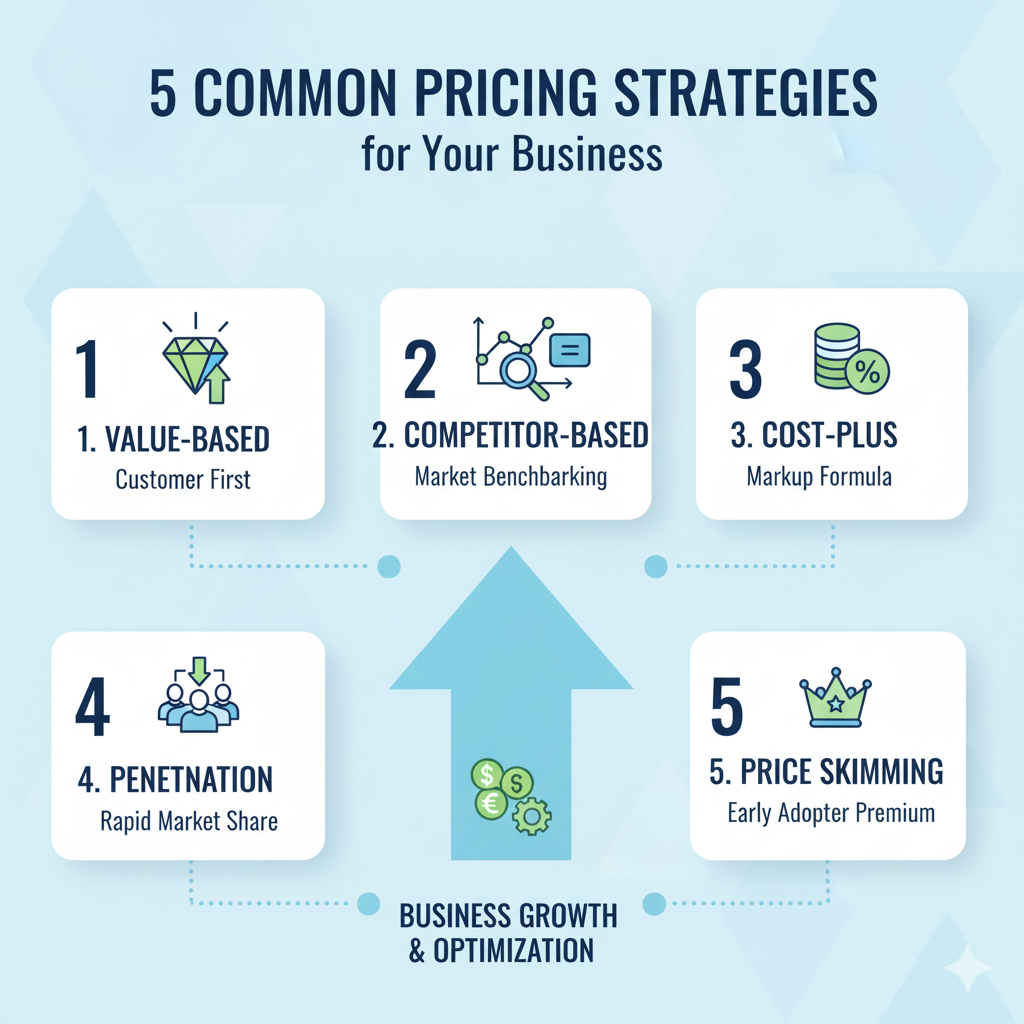
5 Common Pricing Strategies for Your Business
1. Value-Based Pricing
This is the most recommended strategy, especially for SaaS and high-value services.
-
What it is: You set your price based on the perceived value you provide to your customer, not on your internal costs or what competitors charge. You ask, “How much is solving this problem worth to my customer?” or “How much money will they save or make by using my product?”
-
Pros:
-
Allows for the highest profit margins.
-
Aligns your price directly with the value your customer receives, improving customer relationships.
-
Forces you to deeply understand your target audience and your unique selling proposition.
-
-
Cons:
-
Requires significant market research to accurately determine “perceived value.”
-
Can be difficult to quantify, as value can be subjective.
-
2. Competitor-Based Pricing
This is one of the most common and straightforward strategies.
-
What it is: You set your price by benchmarking against what your direct competitors are charging for similar products. You might price slightly lower, at the same level, or slightly higher (to signal premium quality).
-
Pros:
-
Simple and quick to implement.
-
Low-risk, as it anchors your price to an established market rate.
-
-
Cons:
-
Can lead to a “race to the bottom” where you only compete on price, eroding everyone’s profits.
-
It assumes your competitors have a “correct” price, which may not be true.
-
It ignores your own costs and the unique value you offer.
-
3. Cost-Plus Pricing (Markup Pricing)
This is the most traditional and simple pricing method, common in retail and manufacturing.
-
What it is: You calculate the total cost to produce your product (materials, labor, overhead) and add a percentage markup to determine the selling price. (e.g., It costs $50 to make, so you add a 100% markup and sell it for $100).
-
Pros:
-
Very simple to calculate.
-
Guarantees that every sale covers its own costs and contributes a fixed profit.
-
-
Cons:
-
Completely ignores the customer’s willingness to pay and market competition.
-
It’s highly inefficient. You might be leaving a lot of money on the table if customers value your product much more, or you might be overpriced if they don’t.
-
This is generally a poor strategy for SaaS, where the marginal cost of adding a new user is near zero, but the value is high.
-
Key Market Entry Strategies
These two are often used temporarily when launching a new product.
4. Penetration Pricing
-
What it is: You set a very low initial price (sometimes even at a loss) to attract a large number of customers quickly and “penetrate” the market. The goal is to rapidly gain market share.
-
When to use it: In a highly competitive, mass-market industry where you need to build a large user base fast (e.g., a new streaming service or ride-sharing app). The price is often raised later.
5. Price Skimming
-
What it is: The opposite of penetration. You launch a new, innovative product at a very high price to capture the “early adopters” who are willing to pay a premium. Over time, you gradually lower the price to attract more price-sensitive customers.
-
When to use it: For new technology, electronics, or products with a strong brand and little initial competition (e.g., new smartphone models, gaming consoles at launch).
How to Choose?
The best strategy often involves a blend. A good approach is to:
-
Start with Value-Based Pricing: Determine the ideal price based on the value you provide.
-
Check with Competitor-Based Pricing: See where that price lands you relative to competitors.
-
Verify with Cost-Plus Pricing: Do a final check to ensure that this price is well above your costs and provides a healthy profit margin.